Generative AI Consulting Services for Growth-Focused Companies
From strategy to implementation: practical AI that delivers measurable ROI. Every engagement tailored to your business. Serving companies in the United States and LATAM.
Miss Yera provides generative AI consulting services to companies in the United States and Latin America. Our approach combines strategic AI roadmaps, hands-on implementation, governance frameworks, and executive training, delivered by a team with 13+ years of corporate experience at Falabella, Glovo, PedidosYa, Entel, Goodyear, Mondelez and medialabTech. Every engagement is custom-scoped and quoted.
What We Do
Miss Yera is an AI consulting firm led by Gera Flores (Miss Yera), the Leading Woman in Technology in Peru, an MBA Industrial Engineer with 13+ years of corporate experience at leading LATAM companies including Falabella, Glovo, PedidosYa, Entel, Goodyear, Mondelez and medialabTech.
We help companies across the United States and Latin America adopt generative AI in a practical, measurable way. No hype. No black boxes. Just business outcomes.
Our four pillars
- AI Strategy and Roadmap: we assess your digital maturity, identify high-impact use cases, and build a 6-month execution roadmap.
- Hands-on Implementation: we deploy generative AI workflows, AI agents, chatbots, and predictive dashboards tailored to your stack.
- AI Governance and Compliance: we establish policies, controls, and monitoring to ensure responsible AI adoption.
- Executive and Team Training: we train your teams from C-level to operations with 90%+ satisfaction ratings.
Generative AI Development Services
We build and deploy production-grade generative AI solutions. Our generative AI development services include:
- Custom AI Agents: autonomous agents for sales, customer support, data analysis, and operations.
- RAG Systems: retrieval-augmented generation for enterprise knowledge management.
- Workflow Automation: end-to-end automation combining GenAI with tools like n8n, Zapier, and custom APIs.
- Predictive Analytics Dashboards: ML-powered BI with real-time insights.
- Chatbot Development: customer-facing and internal assistants trained on your data.
Typical project timeline: 6 to 12 weeks from kickoff to production.
Industry Verticals
Generative AI for Sales
AI-powered lead scoring, automated prospecting, personalized outreach at scale, and conversational CRM agents. Companies using our approach see 25 to 40 percent lift in qualified lead conversión.
Generative AI for Finance
Invoice processing automation, financial reporting, anomaly detection, forecasting models, and regulatory compliance copilots. Designed for finance teams scaling without headcount increases.
Generative AI for Retail and E-commerce
Dynamic pricing, demand forecasting, personalized recommendations, AI-powered product descriptions, visual search, and customer service automation.
Generative AI for Operations
Predictive maintenance for equipment and fleets, demand and cash flow forecast models, supply chain alerts, and the digital transformation strategies that turn those pilots into a roadmap. These are the three requests that most often arrive from LATAM operations teams, and each one starts with the same readiness assessment.
Generative AI for Knowledge Management
Transform your company documentation into queryable knowledge. Internal chatbots that answer employee questions based on your policies, manuals, and historical data.
AI Governance and Security
Responsible AI adoption requires governance. Our AI governance services include:
- AI usage policies and guidelines
- Data privacy and security compliance (GDPR, CCPA, SOC 2)
- Model risk assessment and monitoring
- Audit trails for AI decisions
- Employee training on responsible AI use
- AI ethics committee setup and facilitation
We align with frameworks including NIST AI RMF, ISO/IEC 42001, and the EU AI Act.
Why Work With Miss Yera
13+ Years Corporate
Experience at Falabella, Glovo, PedidosYa, Entel, Goodyear and Mondelez. We speak business, not just tech.
MBA + Industrial Engineering
Strategic and operational expertise combined.
Proven Track Record
200,000+ professionals trained. 90%+ satisfaction. 85%+ adoption rate on enterprise implementations.
Bilingual Operations
Fluent English and Spanish. Native understanding of LATAM business culture plus US market dynamics.
Recognized Authority
Leading Woman in Technology in Peru. #1 Data Creator in Spanish (Favikon 2025). Nominated to Women in Tech Web3 Awards 2025.
Results-Focused
Measurable ROI. No vanity metrics. No endless deliverables without impact.
Engagement Models
We offer five engagement models, each custom-scoped and quoted based on your specific business needs, scope, industry complexity, and timeline requirements.
| Model | Duration | Investment |
|---|---|---|
| AI Diagnostic | 2 weeks | Custom quote |
| Strategy + Roadmap | 4-6 weeks | Custom quote |
| Implementation Project | 3-6 months | Custom quote |
| Full Transformation | 6-12 months | Custom quote |
| Monthly Advisory Retainer | Monthly | Custom quote |
All engagements start with a complimentary 30-minute consultation to understand your needs before we prepare a detailed proposal with scope, timeline, and investment.
Ready to Start?
The fastest way to see if we are a fit is a 30-minute consultation. No preparation needed. We will discuss your AI goals, review current state, and outline a realistic path forward.
Schedule Your Free Consultation
Or email: hola@missyera.com
Frequently Asked Questions
Do you work with US-based companies?
Yes. We actively work with US companies, especially mid-market and enterprise clients in retail, finance, and technology sectors. Our bilingual operations and LATAM roots are valuable for companies operating across the Americas.
What industries do you specialize in?
Our strongest track record is in retail and e-commerce, financial services, logistics, and corporate training. We have delivered projects for Falabella (retail), Glovo and PedidosYa (logistics), Entel (telecom), Goodyear (manufacturing), and Mondelez (CPG).
How much does a typical engagement cost?
Every engagement is custom-scoped and quoted based on your specific needs, scope, timeline, and industry complexity. We start every relationship with a complimentary 30-minute consultation to understand what you need, then prepare a detailed proposal. Schedule your free consultation to get started.
How quickly can you start?
For diagnostic engagements, within 1 to 2 weeks. For full implementation projects, typically 3 to 4 weeks from contract signature. We maintain capacity for urgent strategic advisory.
Do you handle data privacy and compliance?
Yes. All engagements include data governance, privacy controls aligned with GDPR, CCPA, and sector-specific regulations. We can sign NDAs and BAAs, and we have experience with SOC 2, ISO 27001, and HIPAA-adjacent contexts.
Can you train our internal team?
Yes. Every implementation project includes knowledge transfer. We also offer standalone training programs for executive teams, technical teams, and full organizations. Training ranges from 4-hour workshops to 6-month transformation programs.
Do you have US-based references?
Yes, we can provide references from current and past US and LATAM clients upon request during the consultation process, subject to confidentiality agreements.
Are you an AI automation agency?
Not in the sense of an agency that resells one platform. We build the automation, but we start by deciding whether the process should be automated at all, which is the part most agencies skip because it can end the project. If what you need is someone to wire up flows on a tool you already chose, we can do that too, and we will tell you when a smaller shop would be cheaper for it.
Do you do n8n, Zapier or Power Automate consulting?
Yes, and we stay tool-agnostic on purpose. Power Automate usually wins when the company already lives inside Microsoft. Zapier is fastest to start and gets expensive as volume grows, since it charges per task. Make is cheaper at volume. n8n wins when you want to self-host and stop paying per execution. The right answer is normally decided by where your data already lives, not by which tool is better in the abstract.
Do you offer data analytics consulting, or only AI?
Both, and in most projects the analytics work comes first. Before a model can predict anything, someone has to agree on how a sale is counted, which of the three versions of the number is the right one, and where each field comes from. That work is not glamorous and it is the reason projects either survive or quietly die. We do it as part of the engagement, not as a prerequisite you have to solve alone.
Do you speak at corporate events in English?
Yes. Gera has keynoted in Spanish and English across LATAM, and the talks are built around cases the audience recognizes rather than generic AI slides. Topics range from what AI actually changes for a specific industry to the uncomfortable version: which projects should not be funded. Availability and formats are on the speaker page.
What does an AI readiness assessment cover?
An AI readiness assessment covers five dimensions: data quality and availability, process maturity, team capabilities, existing infrastructure, and alignment with business strategy. The output is a maturity score, opportunities ranked by return, and a ninety day plan, plus a clear build, buy or train recommendation.
Why do AI governance solutions matter before scaling AI?
AI governance solutions matter because a model that cannot be explained, audited or controlled rarely reaches production, especially in regulated sectors. Strong AI compliance defines what a model may decide alone, when a human reviews, and how decisions are logged, so the enterprise can scale AI with confidence instead of shelving it.
AI readiness assessment: what an AI consultant evaluates first
Before recommending a single tool, a credible AI consultant runs an AI readiness assessment across five dimensions:
- Data quality and availability
- Process maturity
- Team capabilities
- Existing infrastructure
- And alignment with business strategy
If a vendor proposes a solution without walking through those five, they are selling software, not generative AI consulting.
In the engagements I run, the readiness assessment is a short, structured phase, not a six month study. It produces a maturity score, a prioritized list of opportunities ranked by return, and a ninety day plan of quick wins. That is what turns it strategy consulting and digital strategy consulting into something a leadership team can actually act on, instead of a deck that ages on a shared drive.
The deliverable also names what to build, what to buy, and what to train, so budget goes where it compounds. For the step by step version, read the pillar on the AI readiness assessment and what an AI consultant does.
For an AI readiness assessment of your organization, book a call or review the AI consulting services.
AI governance solutions and compliance for enterprises
AI governance solutions are no longer optional once models touch customers, credit or hiring. The buyers who get this right do not treat AI compliance as a legal afterthought; they bake it into design, with clear rules on what a model may decide alone, when a human reviews, and how every decision is logged and explained. That is the difference between an enterprise that scales AI and one that quietly shelves a working model because it cannot defend it.
A practical AI governance framework covers four things: an inventory of models and their risk level, explainability proportional to that risk, human in the loop where the stakes are high, and an audit trail regulators or auditors can follow. In regulated LATAM sectors like banking and insurance, this is also what keeps a model from passing the lab and failing to reach production.
Governance is a buying criterion, not a slide. When you evaluate generative AI consulting partners, ask how they handle AI compliance before you ask about models. For the detailed framework, see the pillar on AI governance solutions, and the 2026 blueprint for generative AI governance.
To assess AI governance and compliance for your use cases, book a call.
Strategy consulting across data, business and tech
Beyond AI, the same team offers tech consulting, data strategy consulting and business strategy consulting. Strategy consulting services work best when the advisory connects directly to execution, so the recommendations actually ship instead of aging in a deck.
AI integration services
AI integration is where most value either lands or leaks. AI integration services and generative ai integration connect models to your CRM, ERP and data sources, so the output reaches the people who act on it instead of living in a sandbox.
Choosing an AI consulting partner
Whether you call it an ai consulting agency, an ai consulting company or independent ai consultants, the screening is the same: documented outcomes, governance built in, and a clear path to ai roi. Operator experience in your sector beats a generic pitch every time.
Governance oversight and responsible AI
For regulated work, ai governance oversight and responsible ai governance define who reviews what and how each decision is logged. A responsible ai platform can help, but the framework and the accountability matter more than the tool.
Many programs anchor their controls on an external standard such as the NIST AI Risk Management Framework (AI RMF 1.0), which gives a shared vocabulary for mapping, measuring and managing model risk across the organization.
Preguntas frecuentes
What does an AI consulting engagement include?
It starts with a diagnostic: which processes you run, what shape your data is in, and where something can realistically be automated or predicted with what already exists. The output is a prioritized roadmap. Implementation comes after, scoped to what the diagnostic found.
Do we need clean data before we start?
No. Almost no company starts with clean data, and assessing its state is part of the diagnostic. What is worth knowing upfront is that if the data is very messy, organizing it becomes the first project rather than the automation.
Do you work with companies outside Latin America?
Yes. I work with companies across Latin America and the United States, in English and Spanish. Diagnostics and advisory run remotely; on-site workshops are arranged separately.
How long does an engagement take?
A diagnostic typically takes two to four weeks depending on company size and how many areas are reviewed. Implementation is measured in months and depends on the agreed scope.
Sobre la consultora
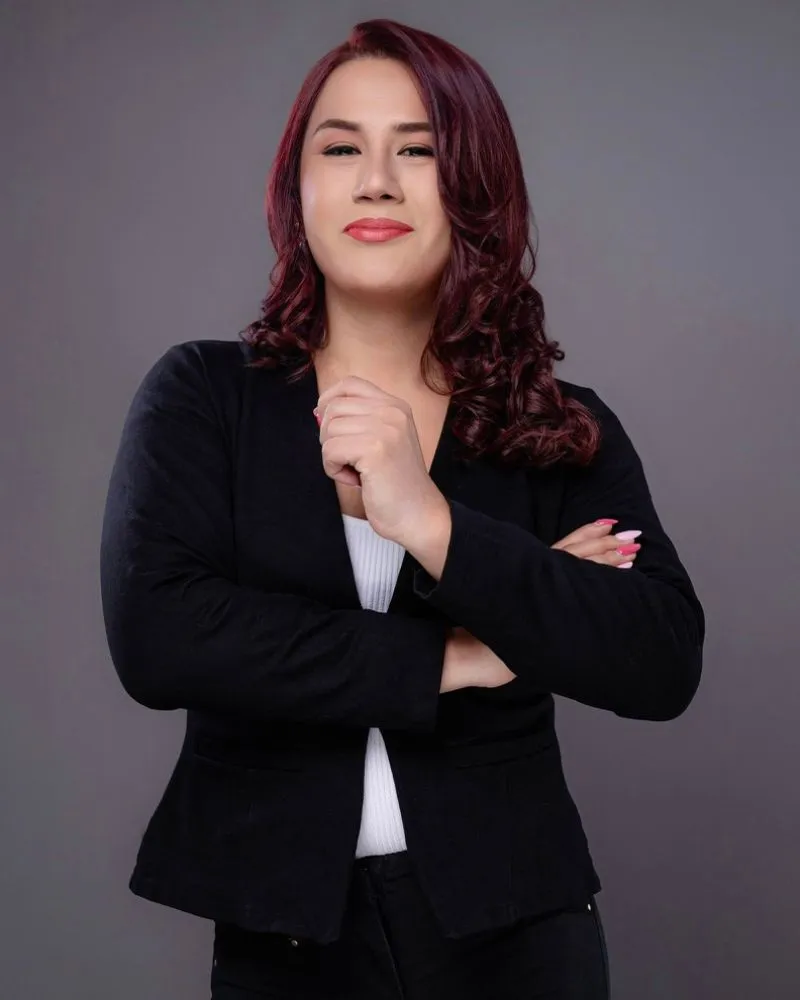
Gera Flores (Miss Yera)
Ingeniera industrial MBA con más de 13 años liderando proyectos de analítica e IA en empresas transnacionales a nivel LATAM. Docente, consultora y conferencista con más de 100 conferencias realizadas y más de 200 mil personas impactadas.
¿Listo para dar el siguiente paso?
Agenda un diagnóstico gratuito de 30 minutos. Evaluamos tu caso y te decimos exactamente qué puedes lograr con IA.
Quién te recibe
Gera Flores (Miss Yera). Mujer Tech #1 en Perú. Consultora de IA #1 en español según Favikon 2025.
Detrás del trabajo
+13 años en Falabella, Glovo, PedidosYa, Entel, Goodyear y Mondelez. Comunidad de +200,000 personas y 90%+ de satisfacción en proyectos corporativos.